


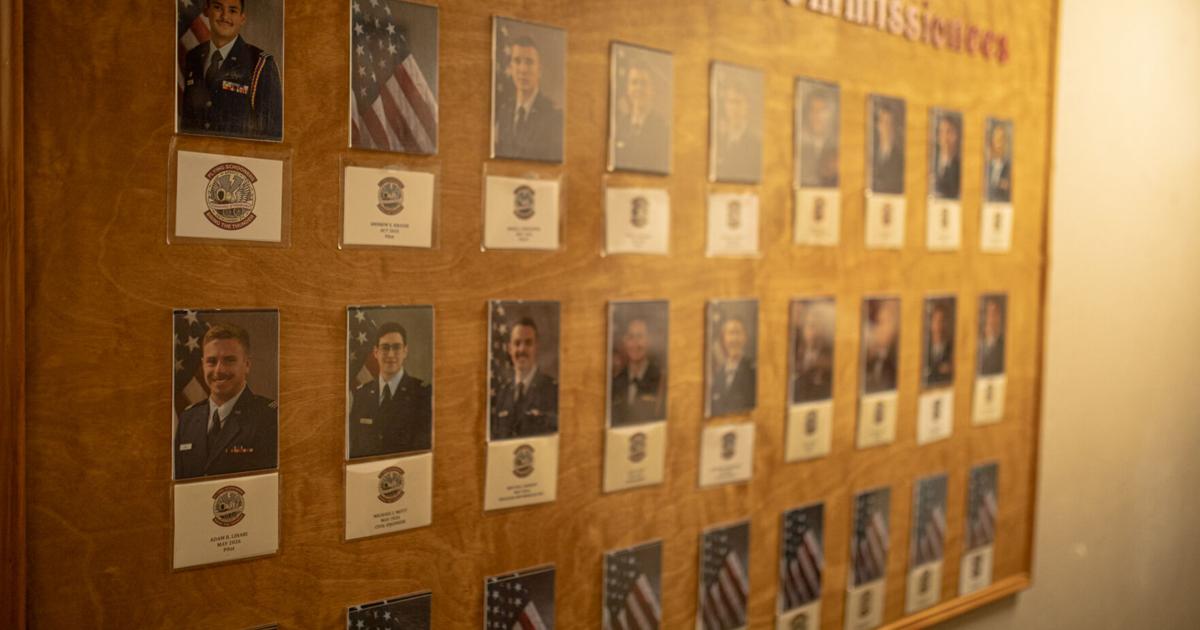
For over seven decades, Air Force ROTC Detachment 675 has provided undergraduate students the opportunity to become future leaders in the U.S. Air Force.
Members of the Air Force Reserve Officers Training Corps, or ROTC, said the detachment allows students, also known as cadets, to earn a minor in aerospace studies while learning critical thinking and leadership skills.
While it is ideal to begin the program as a freshman, as it takes four years to complete, cadets can join in the fall semester of their sophomore year and compress the requirements into three years, according to the detachment’s website. Cadets are broken up into wings, groups, squadrons and flights to mirror the Air Force’s wing structure.
Cadets enter into the General Military Course for their first two years in the program. This course consists of a one-credit-hour aerospace studies class, which introduces cadets to aerospace studies and provides a background to the field. Additionally, cadets attend a Leadership Laboratory class once a week and physical training twice a week, according to the detachment’s website.
Capt. Travis Moore, education officer, said the program divides its training between physical training and an academic classroom program.
“As for your freshman and sophomore year, it’s actually just one credit hour, so it’s pretty small as far as the academic load goes,” Moore said. “That scales up to three credit hours for your last two years in this program.”
Moore spoke about what underclassmen can expect from the one-credit-hour class.
“We’re teaching you history of the Air Force and Space Force, the Department of the Air Force, and then customs and courtesies,” Moore said.
Moore said the program teaches leadership and followership traits through classes like Public Speaking. He said these classes are a primer for students to determine if they are interested in the military.
In the last two years of the program, eligible cadets can take the Professional Officer Course, which focuses on training cadets to succeed as officers in the Air Force, according to the ROTC’s website. Cadets must be fully qualified for Air Force commission, nominated by the Professor of Aerospace Studies and selected by a Headquarters Air Force ROTC board. During the summer before their junior year, cadets sign a commitment to serve a contract and spend two weeks in field training at Maxwell Air Force Base in Alabama.
Moore said the Professional Officer Course is mostly about operational and strategic level leadership and fellowship, and cadets learn about leading and motivating others.
Cadets take AERO 1300, titled Leadership Laboratory, where they put what they’ve learned about leadership and followership into practice, according to Moore.
Through the course, upperclassmen perform leadership tasks while running a cadet wing. The students lead 130 to 175 of their peers to accomplish tasks for a given week.
“They basically mimic what a normal active duty wing would look like,” Moore said.
Moore said cadet activities prepare students for the program’s physical fitness test. The test consists of one minute of push-ups, one minute of sit-ups, a 1.5 mile run and an abdominal measurement, according to the U.S Air Force ROTC website.
“We have (physical training) Tuesdays and Thursday mornings from 6 to 7 a.m.,” Moore said. “It’s a combination of calisthenics, cardio and strength training.”
Moore also highlighted benefits such as in-state tuition for out of state cadets, scholarships, monthly stipends and the chance to become a commissioned officer in the Air Force.
“If you’re an active cadet and enrolled in the program, then you immediately get in-state tuition,” Moore said.
The program includes up to a $900 stipend for textbooks and a monthly stipend that ranges from $250 to $450 a month. Moore also noted some scholarships can cover up to 100% of tuition and fees.
“Ultimately, those that are successful and finish out the four-year program get a guaranteed job as a commissioned officer,” said Moore.
Moore said the pay for commissioned officers is fairly competitive with starting pay around $65,000 a year on average. Within the first four years, officers will make over $100,000 a year, according to Moore.
Moore encouraged prospective students to try out the program.
“Don’t overthink it, because there is no immediate commitment. … It’s just two classes that you take,” Moore said.
Moore said all it takes is for students to put in effort and show up with good energy.
“Just have five hours of availability to do all the things we require you to do, and if you’re willing to do that, then just come out and try it out,” Moore said. “Worst case you become a better public speaker, better leader, better follower.”


OU Air Force ROTC cadets during the interview on Dec. 1.
Cadets Hailey Ratlief, nursing senior, Nathan Frasco, organized leadership junior, and Mike Harley, criminology senior, sat down with OU Daily to speak on their experience and why they joined the program.
All three cadets have parents who were members of the Air Force, and they wanted to follow in their footsteps. Nathan Frasco said his dad was part of Detachment 675 when he was at OU.
“It seemed like a really awesome thing to do and I just wanted to follow in his footsteps,” Frasco said.
OU Air Force ROTC Cadet Nathan Frasco during the interview on Dec. 1.
Hailey Ratlief said scholarships and a pathway to nursing made her want to join.
“I came into the program immediately on scholarship from high school, so that was a huge benefit. …Then being guaranteed to be a nurse through this program too, it kind of just gives you job security (after graduation) that some people don’t have,” Ratlief said. “Things like insurance, having a house, where you’re going to go, all of those things, it’s taken care of.”
Ratlief also said that cadets gain leadership skills they can take into any career.
OU Air Force ROTC Cadet Hailey Ratlief during the interview on Dec. 1.
Mike Harley gave his perspective as an upperclassman in the detachment on how they use the skills they’ve learned to mentor underclassmen.
“I hope to take away from this point on, from an upperclassman stand point, is to be able to pass on the knowledge that I have accumulated and the skills that I have accumulated to those underneath me,” Harley said. “So we can continue to develop what will be the future leaders of tomorrow.”
Harley said forming bonds with other cadets has been one of his favorite parts of the program.
“You come into the program, and you go through both thick and thin with these people. Who else would you want to spend your time with?” Harley said. “They know you best, they spend the most time with you. … These are my people and they’re going to be who I hang out with.”
OU Air Force ROTC Cadet Mike Harley during the interview on Dec. 1.
Frasco said his favorite part of the program is the amenities. He enjoys the heritage room located in the detachment, which is a study and hangout area where cadets can spend their downtime.
“There’s (PlayStation 5’s), Nintendo Switches. We have snack bars (and) flight simulators with pretty recent software you can spend all day on,” Frasco said.
In a message to prospective students, Harley said to keep an open mind.
“There are so many opportunities available to you,” Harley said. “You just have to be willing to leave that door open.”
Following graduation, Ratlief plans to become a labor and delivery nurse at Elmendorf Air Force Base in Alaska and Harley plans to become a pilot at Columbus Air Force Base in Mississippi. Frasco is a junior and is awaiting placement.
If students are interested in joining Detachment 675, they can reach out to the recruiting flight commander at afrotc.det675@ou.edu or visit the detachment’s website.
This story was edited by Ana Barboza and Audrey McClour. Larkin Bock and Sophie Hemker copy edited this article.
link