Sylvester Comprehensive Cancer Center Launches Broader Leadership Development Program
Share
The initiative is a series of workshops that strengthen leadership skills, promote collaboration and prepare faculty members to assume expanded roles in the cancer center and the University of Miami community.

Strategic leadership can sometimes feel like a tightrope act. Leaders are asked to balance competing priorities while helping to create and guide a steady team vision.
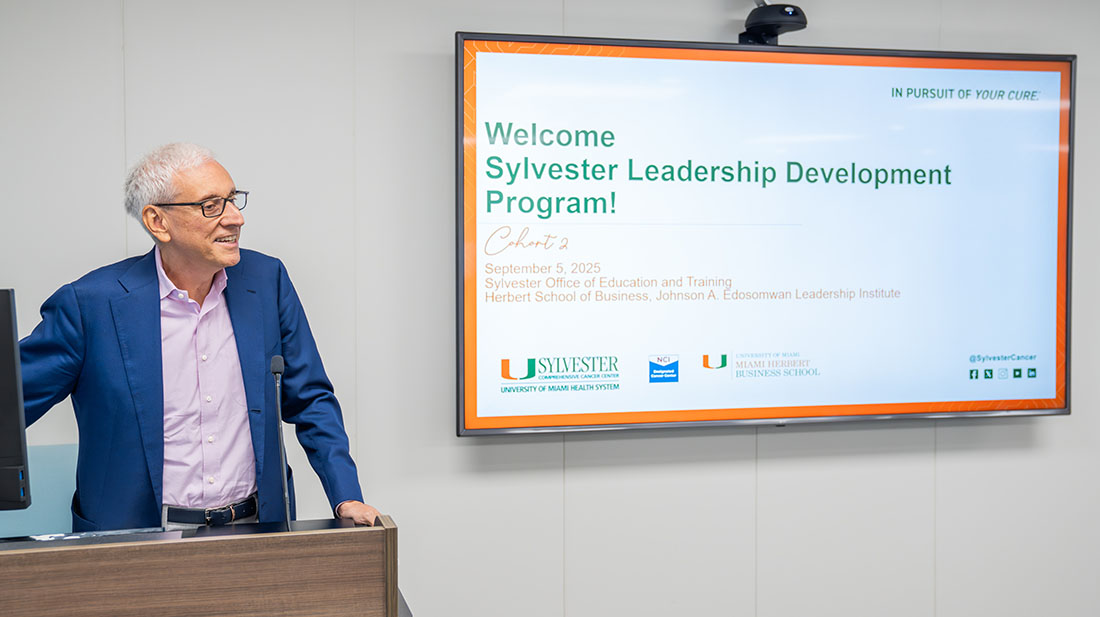
Aiming to equip leaders to reliably address such push-and-pull demands, Sylvester Comprehensive Cancer Center, part of the University of Miami Miller School of Medicine, recently unveiled its rebranded Sylvester Leadership Development Program. A new cohort of faculty participants assembled for the kickoff on Sept. 5, which included the first of a year-long series of workshops to strengthen leadership skills, promote collaboration and prepare faculty members to assume expanded roles in the cancer center and the University of Miami community.

“This program offers an invaluable chance to integrate my scientific interests with institutional leadership,” said program participant Alberto J. Caban-Martinez, D.O., Ph.D., M.P.H., deputy director of the Sylvester Firefighter Cancer Initiative (SFCI) and professor of public health sciences and associate vice provost for research regulation, integrity, security and evaluation at the Miller School. “I view it as a launching point for deeper engagement, bigger ideas and more impactful contributions to cancer prevention and control.”
A Program Built for Growth and Advancement
The program, developed in collaboration with the Miami Herbert Business School’s Johnson A. Edosomwan Leadership Institute, helps talented, motivated faculty members develop additional skills for leadership in academic medicine and cancer research.
Through interactive workshops spearheaded by business school faculty members and targeted presentations from Sylvester and Miller School leaders, participants gain practical insights into leadership fundamentals, such as effective communication, decision-making and team building, while also exploring topics unique to National Cancer Institute-designated cancer centers.

“Leadership is more than strategies. It’s about people,” said Lauren Whitmore, assistant vice president and associate director for research administration at Sylvester, who directs the program. “This program is about equipping our faculty with the tools to translate the mission and vision of our cancer center into action — to lead teams, spark innovation and create impact in our community.”
Program operations are overseen by Vaughn Edelson, M.P.A., M.P.H., director of research support in the Sylvester Office of Education and Training, and Shemir Dauphin, project manager in the research lab of molecular geneticist Sophia George, Ph.D., associate professor of obstetrics, gynecology and reproductive sciences.
New Name Reflects a Broader Focus
The program debuted last year with a focus on working with assistant and associate professors in the early or middle stages of their careers. But as faculty needs and leadership roles throughout the cancer center have evolved, so has the program.
Beginning this year, eligibility is open to all Sylvester faculty members with at least five years of service. This includes faculty members recently promoted into leadership roles as well as those in leadership positions throughout the Miller School and the University of Miami who want to deepen their engagement with the cancer center.

“Good leadership starts with listening,” Whitmore explained. “We heard from our faculty that there was a need for broader support. Partnering with Dr. Kerry Burnstein, chair of the Miller School’s Department of Molecular and Cellular Pharmacology and associate director for education and training at Sylvester, and our Cancer Education Leadership Council, we redesigned the program to meet the evolving needs of our faculty at every career stage. Calling this the Leadership Development Program reflects not just a name change, but a deeper commitment to growth.”
The Cancer Education Leadership Council, which includes faculty members, trainees and community representatives, links researchers and health professionals with Sylvester’s cancer research efforts.
Sylvester Leadership Development Program participants engage in monthly, three-hour, in-person workshops from September through May. The interactive sessions combine research-based frameworks with practical exercises.
Lessons in Leadership
Curriculum topics include:
• Leadership fundamentals: Explores the core principles of leadership, including differences between leadership and management, leadership styles and the importance of self-awareness in leadership
• Decision-making: Examines decision-making processes, types of decisions and the role of leadership in shaping organizational direction
• Communication skills: Provides practical insights, interactive exercises and personalized feedback to help participants enhance communication capabilities to achieve leadership goals
• Resolving conflict: Considers how conflict can be thoughtfully managed to produce nuanced assessments of proposed decisions while minimizing human costs, such as stress and strained professional relationships
• Overview of NCI-Designated cancer centers: Offers an overview of core requirements and strategic priorities of NCI-designated cancer centers and how designation criteria affect research, clinical care, community engagement and administration
Other topics include trust-building, inspiring others, effective team-leading and promoting creativity and innovation.
“A key goal of mine is to understand how leadership works at an institutional level,” said program participant Daphne Avgousti, Ph.D., associate professor of molecular and cellular pharmacology. “I have been a leader in my own lab and am eager to contribute to the success of the university and the cancer center. This program is an ideal way to prepare to do so.”
The opening day included a welcome lunch and remarks from Whitmore, Antonio Iavarone, M.D., professor of neurological surgery, biochemistry and molecular biology, director of the Sylvester Brain Tumor Institute (SBTI) and deputy director of Sylvester, and Marina McCarthy, Ph.D., Herbert Business School associate professor of professional practice. The first workshop, Introduction to Leadership Fundamentals, followed. Participants’ mentors attended the first session, in recognition of the value of mentorship and support throughout an individual’s career.
“Leadership in health care and cancer research requires vision and practical skills,” said Dr. McCarthy. “Through this collaboration, we are proud to be helping Sylvester faculty members add to their clinical and research expertise and commitment to patient health by expanding their leadership skills, such as guiding teams, making strong decisions and steering innovation that benefits patients and the community as a whole.”
“It’s always inspiring to feel the energy in the room on day one,” Whitmore added. “Our people are the heart of Sylvester. When we invest in their leadership, we’re investing in the future of cancer care and in the patients and communities who count on us.”
Tags: Dr. Alberto Caban-Martinez, Dr. Antonio Iavarone, Dr. Daphne Avgousti, Dr. Kerry Burnstein, Sylvester Comprehensive Cancer Center
link